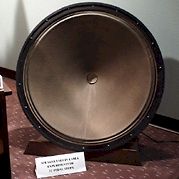
Large speaker used in early experiment of 32' Pedal Stops
During the Early Analog Years:
- 1947: Allen installed the world's first three-manual electronic organ in St. Paul's Lutheran Church in Catasauqua, Pa. Years later, when a fire in the church damaged that organ, it was replaced with a new three-manual Allen digital organ.
- 1949: Full-range, high-fidelity stereo audio equipment was incorporated in Allen installations. These tone cabinets incorporated 15" and 12" speakers plus special horn tweeters for the highest frequencies. Speakers were also placed on the baffle of the Gyrophonic Projector. During this time, the Allen was the only electronic organ available spanning this wide range of musical frequencies.
- 1950: “Purely Electronic Carillon,” “Harp Percussion,” and sustain effects were introduced. The Carillon could be connected to outside speakers for a fine low-cost outdoor Carillon.
